
When Google’s engineers set out to create a new programming language in 2007, they weren’t chasing academic elegance or theoretical perfection. They were solving real problems: slow compilation times, complex dependencies, and the growing challenges of building and maintaining massive distributed systems. The result was Golang – a language that has quietly become the backbone of modern cloud infrastructure.
Today, Golang powers some of the most critical systems in technology. Docker, Kubernetes, Terraform, Prometheus, etcd – these aren’t just popular tools, they’re the foundation of cloud-native computing. When you deploy a container, orchestrate a cluster, or provision infrastructure as code, there’s a good chance you’re relying on software written in Go.
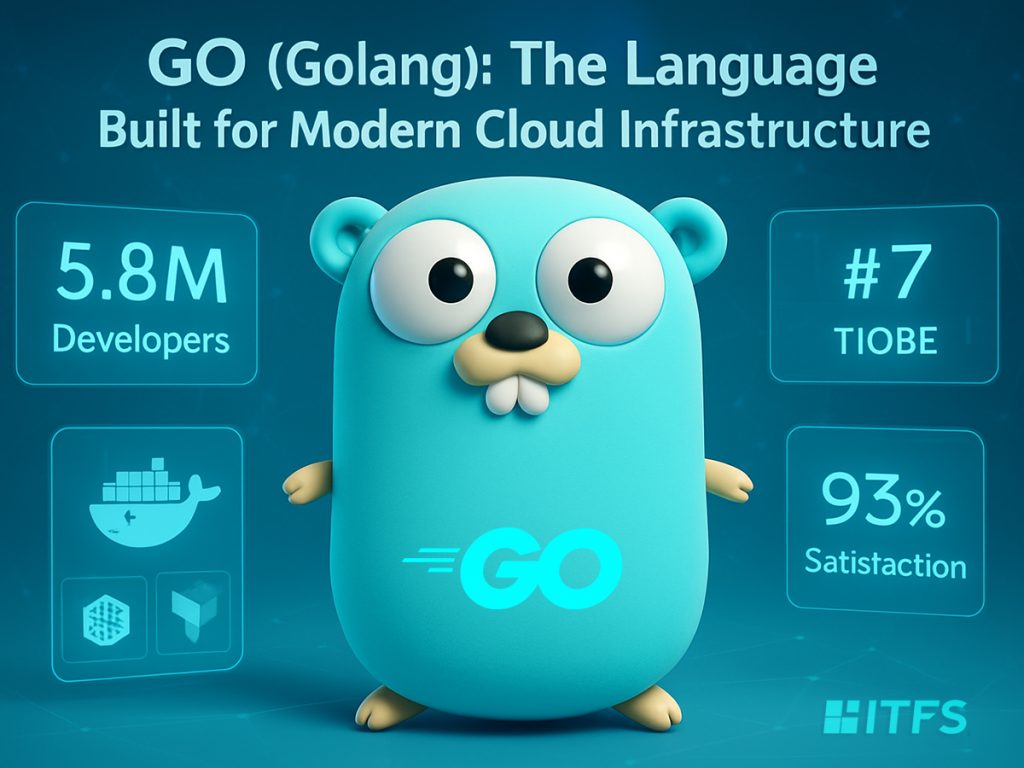
The numbers tell a compelling story. With approximately 5.8 million developers worldwide using Golang in 2024, the language has grown from a Google experiment into a mainstream choice for performance-critical applications. Go ranks 7th in the TIOBE Index as of November 2024 – its highest position ever – and has become the third fastest-growing language on GitHub, trailing only Python and TypeScript.
But adoption statistics only tell part of the story. The real question is: why has Go become the default choice for cloud infrastructure, microservices, and DevOps tools?
The Cloud-Native Language
Go wasn’t just designed for the cloud era – it was designed because of it. Google created Go specifically to address the challenges of building software at scale, where thousands of services need to communicate efficiently, handle massive concurrent loads, and deploy reliably across distributed systems.
The language’s design philosophy reflects this pragmatic origin. Go favors simplicity over cleverness, clarity over complexity, and performance over abstraction. With just 25 keywords – compared to Java’s 50+ or C++’s 80+ – Go creates what developers describe as a remarkably “low cognitive load”. You spend time solving problems, not fighting syntax.
This simplicity isn’t just theoretical – it translates directly into developer productivity. According to the 2024 Go Developer Survey, 93% of respondents report satisfaction with the language, with many citing ease of onboarding and code maintainability as key factors. When Cockroach Labs evaluated Go for their distributed database, they found developers could become productive faster than with other languages.
The Concurrency Advantage
In cloud computing, concurrency isn’t optional – it’s fundamental. Modern applications need to handle thousands or millions of simultaneous connections, process streams of data, and coordinate across distributed systems. Traditional threading models make this difficult, requiring complex synchronization logic that’s error-prone and hard to maintain.
Go approaches concurrency differently. Goroutines – lightweight functions that run concurrently – are so efficient that you can spawn thousands or even millions of them without overwhelming your system. A goroutine typically uses just 2KB of memory compared to a traditional thread’s 1-2MB, making truly massive concurrency practical.
But the real innovation isn’t just goroutines – it’s channels. Golang’s channel-based communication system provides a simple, safe way to pass data between concurrent processes, eliminating entire categories of race conditions and deadlocks that plague traditional concurrent programming. This architecture has proven essential for cloud computing, where handling multiple simultaneous requests efficiently can make or break an application’s viability.
The market has taken notice. Go now accounts for 12% of all automated API requests globally, surpassing Node.js – a significant shift that reflects the language’s growing dominance in high-concurrency applications.

Performance That Scales
When you’re running services across hundreds or thousands of servers, efficiency matters. Go compiles to native machine code, delivering performance comparable to C++ or Rust while maintaining a simple, readable syntax. Unlike interpreted languages or those requiring a virtual machine, Golang applications start instantly and run with minimal overhead.
This performance advantage translates directly into cost savings. When Uber optimized their Go services using Profile-Guided Optimization, they achieved approximately 4% performance improvement – eliminating the need for 24,000 CPU cores across their top services. At scale, even small efficiency gains compound into substantial infrastructure savings.
Capital One reported 90% cost savings after moving certain services to Go, while Twitch achieved a 30% reduction in CPU utilization and a 45% improvement in 99th percentile API latency during peak load through Go optimization techniques.
Deployment Simplicity
Golang’s compilation model produces a single, self-contained binary. Everything your application needs – all code, libraries, and dependencies – gets packaged into one executable file. No runtime installation, no dependency management headaches, no version conflicts. Just copy the binary and run it.
This simplicity revolutionizes deployment. Docker images for Golang applications can be incredibly small – sometimes just megabytes – because they don’t need to bundle an entire language runtime. Kubernetes configuration becomes straightforward. CI/CD pipelines simplify dramatically.
For DevOps teams managing hundreds of microservices, this advantage is transformative. It’s why tools like Docker, Kubernetes, and Terraform are themselves written in Go – the language’s deployment model aligns perfectly with cloud-native philosophies.
Industry Leaders Powered by Golang
When you examine which companies use Golang and why, a pattern emerges: organizations choose Golang when performance, reliability, and scalability aren’t optional features but fundamental requirements.
Google: Where It All Began
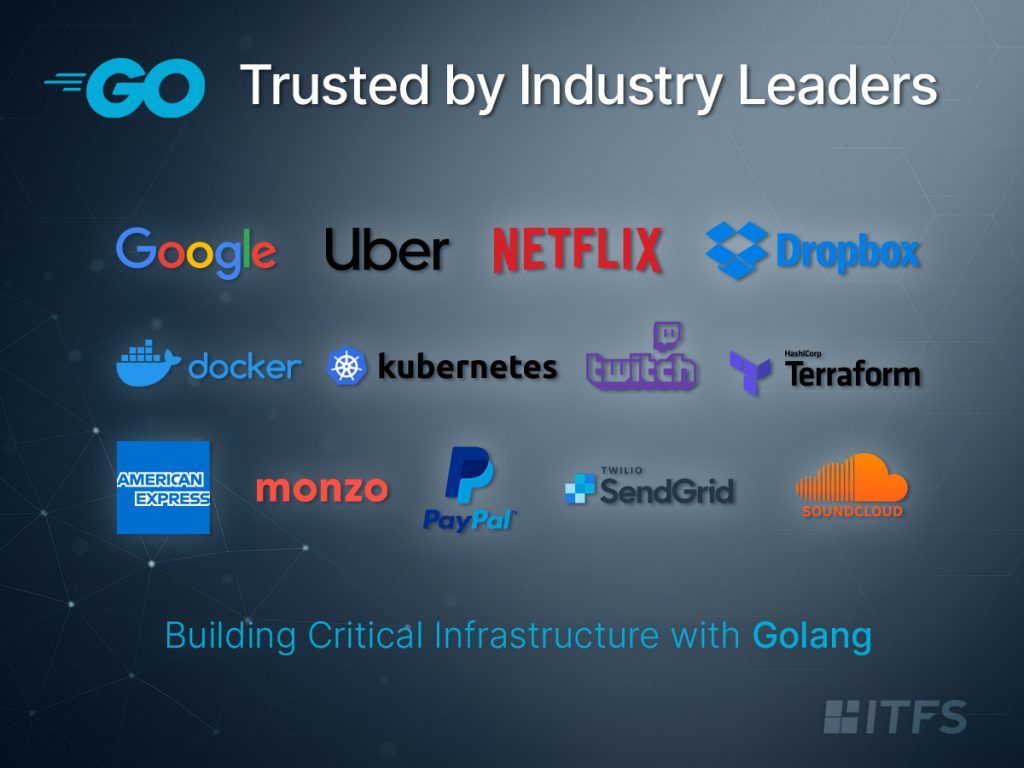
As Golang’s creator, Google naturally leads in adoption. The company uses Go extensively across its infrastructure, including systems that power Google Chrome, Google Earth, YouTube, and Google App Engine. For an organization managing some of the world’s most demanding computing systems, Golang’s combination of high-speed execution, robust performance, and streamlined development workflows proved essential.
Uber: Handling 170,000 Queries Per Second
Uber integrates Go into its backend infrastructure to manage high-throughput services like geofencing and real-time rider-driver matching. Handling up to 170,000 queries per second, the company requires a language that offers low latency and high reliability.
According to Kai Wei from Uber’s engineering team, the ease with which developers proficient in C++, Java, or Node.js could transition to Go proved invaluable. The geofence service, built in Go, has achieved 99.99% uptime since deployment – a level of reliability essential for a platform where downtime directly impacts millions of users.
Uber’s Go codebase now spans over 46 million lines across approximately 2,100 microservices. Using Golang’s built-in race detector, they identified over 2,000 race conditions and fixed more than 1,000 bugs with 790 patches submitted by 210 developers in just six months.
Netflix: Streaming at Global Scale
Netflix uses Go across critical infrastructure components that keep their global entertainment platform running smoothly. With millions of subscribers streaming simultaneously, performance bottlenecks aren’t acceptable. Golang’s small memory footprint and fast startup times make it ideal for Netflix’s containerized deployment strategy, enabling the resilient infrastructure that supports high-quality streaming without performance degradation.
Dropbox: Managing 500 Million Users
Cloud storage pioneer Dropbox made one of the tech industry’s boldest migration decisions when they rewrote key backend services from Python to Go. Managing 500 million users and petabytes of data required a language that could scale efficiently.
The migration delivered dramatic improvements. Golang’s efficiency enabled faster file synchronization, more efficient use of server resources, and reduced operational costs. Zviad Metreveli, Senior Principal Engineer at Dropbox, highlighted that Golang’s ease of adoption enabled engineers to become highly productive quickly, accelerating development cycles.
Dropbox built custom internal libraries using Golang, enabling them to fine-tune caching mechanisms and standardize error handling across their infrastructure – investments that paid off with enhanced performance and better scalability.
Twitch: 15 Million Daily Active Users
Live streaming presents unique technical challenges. Twitch, with over 15 million daily active users, discovered Go essential for powering its most critical infrastructure components. The platform’s video processing pipeline handles massive concurrent loads, where “refresh storms” can cause 20x normal load in seconds.
Golang’s concurrency capabilities proved crucial. Between Go versions 1.4 and 1.6, Twitch achieved a 20x improvement in garbage collection pause times. By Go 1.7, typical pause times dropped to approximately 1ms – a 10x improvement that directly translated into better streaming quality and user experience.
Other Industry Leaders
The list of major companies using Golang extensively includes:
- SendGrid: Processing over 500 million emails daily using Golang as their primary programming language
- SoundCloud: Running six complete services and dozens of repositories entirely in Go
- American Express: Using Go to handle critical transaction systems where performance and security are non-negotiable
- Monzo: Building their mobile-first banking backend almost entirely in Go, giving them full control and clear structure
- PayPal: Employing Go for payment processing systems to handle transactions more quickly while maintaining strict security requirements
Over 40% of organizations using Golang heavily operate in the technology sector, with financial services coming next at 13%.
The Foundation of Cloud-Native Computing
Golang’s influence extends beyond individual companies. The language has become the de facto standard for building the infrastructure tools that power modern cloud computing.
Kubernetes: Orchestrating the Cloud
Kubernetes, the leading platform for container orchestration, was developed using Golang. Managing containerized applications at scale requires handling complex deployments, coordinating distributed systems, and ensuring efficiency in cloud environments – exactly the scenarios where Go excels.
Kubernetes’ widespread adoption across startups and enterprises highlights Golang’s effectiveness in managing distributed systems. The platform’s ability to handle millions of containers across thousands of servers relies fundamentally on Golang’s concurrency model and performance characteristics.
Docker: Revolutionizing Deployment
Docker’s virtualization technology is responsive because of Go. The Docker team chose Go specifically because it enabled them to work efficiently with Linux, execute low-level system calls, and build a containerization platform faster than would have been possible with other languages.
Docker’s minimal resource requirements – a key advantage that enabled its widespread adoption – stem directly from Golang’s efficiency and lightweight runtime.
Terraform: Infrastructure as Code
HashiCorp’s Terraform, which has become the standard for infrastructure provisioning, is written entirely in Go. The tool’s ability to manage complex multi-cloud infrastructure reliably while maintaining fast performance depends on Golang’s strengths: native performance, clear error handling, and efficient concurrency.
The Complete Ecosystem
The cloud-native ecosystem’s reliance on Go extends further:
- Prometheus: The monitoring and alerting system that’s become standard for Kubernetes environments
- etcd: The distributed key-value store that powers Kubernetes’ configuration management
- Consul: HashiCorp’s service mesh and service discovery tool
- Vault: HashiCorp’s secrets management solution
- CockroachDB: The distributed SQL database designed for cloud deployments
This isn’t coincidence – it’s validation. When the engineers building the infrastructure for cloud computing choose a language, they consistently choose Golang.
When Golang Is The Right Choice
Go isn’t the answer to every problem. Like any tool, it excels in specific scenarios while other languages may be better suited for different use cases.
ose ITFS, you’re partnering with a company that’s been perfecting IT outsourcing since 2012. We deliver what matters most: the right people, at the right time, with the right support.
Where Go Excels
If you’re building RESTful APIs, microservices, or backend services that need to handle thousands of concurrent connections, Go is purpose-built for this workload. The language’s standard library includes robust HTTP server support, excellent JSON handling, and built-in concurrency primitives that make building high-performance APIs straightforward.
According to the JetBrains State of Developer Ecosystem Report 2025, approximately 1.9 million developers work on web services, websites, and business applications built with Go microservices.
Go has become the lingua franca of DevOps. The language’s ability to produce single-binary executables makes building and distributing CLI tools trivial. Whether you’re creating deployment scripts, monitoring agents, or infrastructure automation tools, Golang’s compilation model eliminates the “works on my machine” problem entirely.
Approximately 1 million Golang developers work on managing cloud services or internal IT infrastructure platforms, including Kubernetes cluster operators and infrastructure-as-code tools.
If you’re building systems that manage containers, orchestrate workloads, or provision infrastructure, you’re following in the footsteps of Kubernetes and Docker. Golang’s performance, deployment simplicity, and excellent support for systems programming make it ideal for this domain.
When you need to process streams of data, transform information in real-time, or build ETL (Extract, Transform, Load) pipelines, Golang’s concurrency features enable efficient parallel processing. Companies like Uber use Golang extensively for data processing tasks that require both high throughput and low latency.
For applications that involve low-level networking, protocol implementation, or high-throughput data streaming, Golang’s performance characteristics and concurrency model provide significant advantages. The standard library includes comprehensive networking primitives, making it straightforward to build everything from simple TCP servers to complex distributed systems.
Where Other Languages May Be Better
While Go is expanding into AI infrastructure, Python remains dominant for machine learning and data science due to its extensive libraries (TensorFlow, PyTorch, scikit-learn) and scientific computing ecosystem. Go excels at serving ML models in production but isn’t typically the first choice for model development and training.
Go wasn’t designed for building desktop GUI applications or frontend web development. For these scenarios, languages like JavaScript/TypeScript, Swift, or C# with their rich UI frameworks offer better tooling and ecosystem support.
While Go can be used for mobile development through frameworks like Gomobile, native development with Swift (iOS) or Kotlin (Android) generally provides better performance, platform integration, and developer experience for mobile apps.
For quick prototypes or scripts where performance isn’t critical, languages like Python or Ruby often offer faster development cycles due to their dynamic typing and extensive libraries. Golang’s static typing and compilation step add discipline that’s valuable for production systems but can slow down exploratory development.
The Developer Experience
Beyond technical capabilities, Go offers developers something increasingly valuable: a pleasant, productive experience that leads to high satisfaction and low turnover.
Learning Curve
Golang’s simplicity makes it remarkably accessible. Developers with experience in languages like C, Java, or Python can typically become productive in Go within days or weeks, not months. The language specification is short enough to read in an afternoon, and the standard library is comprehensive but not overwhelming.
This ease of adoption has practical business implications. Companies like Delivery Hero report that Go eliminated typical development hurdles, allowing teams to focus on building high-quality applications rather than fighting language complexity.
Tooling Excellence
Golang’s tooling ecosystem deserves special mention. The language ships with excellent built-in tools:
- gofmt: Automatically formats code to standard style, eliminating debates about code formatting
- go test: Built-in testing framework with no external dependencies required
- go mod: Dependency management that actually works
- go doc: Automatic documentation generation from code comments
- Race detector: Built-in tool for detecting race conditions in concurrent code
Modern IDEs provide excellent support for Go development, with features like intelligent code completion, refactoring tools, and integrated debugging that streamline the development workflow.
The static analysis and linting ecosystem is particularly strong. Tools like golangci-lint have become standard in professional projects, running multiple linters in parallel with caching for speed. It integrates with all major IDEs, enabling a “shift-left approach” where issues are caught during development rather than in CI/CD pipelines.
High Developer Satisfaction
The numbers speak clearly: 93% of Golang developers report satisfaction with the language. This isn’t just about liking the syntax – it’s about sustained productivity, manageable codebases, and systems that remain maintainable as they scale.
Companies report that Go enables developers to move from concept to production remarkably quickly. SoundCloud engineers describe getting ideas into production in under an hour, while maintaining code quality and reliability.
Career Prospects and Compensation
For developers, Go skills translate directly into career opportunities and competitive compensation. Golang developers are among the highest-paid in the industry, with average salaries in the United States ranging from $122,000 to $137,500 annually.
Senior Golang developers in major tech hubs can command significantly higher compensation, with experienced professionals earning $177,000+ and top earners in the United States reporting salaries up to $227,000.
This premium reflects both the language’s value in building performance-critical systems and the growing demand that outpaces supply. According to the JetBrains Language Promise Index, Go ranks fourth for planned adoption – trailing only TypeScript, Rust, and Python – with 11% of all software developers planning to adopt Go in the next 12 months.
The Ecosystem Continues to Evolve
Go isn’t standing still. The language continues to evolve thoughtfully, with regular releases that refine the developer experience while maintaining backward compatibility.
Recent Developments
In 2024, Go saw two major version releases (Go 1.22 and Go 1.23), followed by Go 1.24 in February 2025. These updates focused on refining developer experience, stability, and telemetry-based improvements.
Go 1.18 introduced generics, addressing one of the language’s most requested features. While Go remains conservative about adding complexity, generics enable more expressive code without sacrificing the language’s core simplicity.

Growing Framework Ecosystem
While Go has historically emphasized its standard library over frameworks, the ecosystem has matured significantly:
- Gin: Lightweight web framework that’s become popular for building APIs quickly
- Echo: High-performance, extensible web framework
- Fiber: Express-inspired framework built on top of Fasthttp
- Chi: Lightweight, idiomatic router for building HTTP services
These frameworks complement Golang’s standard library rather than replacing it, giving developers options for different productivity/control tradeoffs.
Expanding Into New Domains
The Go team has declared interest in AI model serving – an emerging area that offers exciting opportunities for Golang’s adoption. While Python dominates AI development, Golang’s performance characteristics make it compelling for serving AI models in production environments where latency and throughput matter.
Nearly half of all Golang developers now target ARM64 architecture, indicating significant growth in edge computing and performance-optimized servers. This trend positions Go well for the next generation of distributed computing.
Real-World Impact: Beyond the Hype
The true measure of a programming language isn’t its features – it’s the results teams achieve using it. Golang’s track record speaks clearly:
Infrastructure Efficiency: Uber eliminated 24,000 CPU cores through optimization. Capital One achieved 90% cost savings on certain services. These aren’t marginal improvements – they’re transformative results that directly impact business economics.
Reliability at Scale: Uber’s geofence service maintains 99.99% uptime. Twitch handles 20x traffic surges without degradation. Monzo processes thousands of banking transactions per second with confidence. Go enables the kind of reliability where downtime carries substantial business consequences.
Development Velocity: Teams consistently report faster development cycles with Go. The combination of simple syntax, excellent tooling, and comprehensive standard library means developers spend time solving business problems rather than fighting the language or toolchain.
Operational Simplicity: Single-binary deployment, minimal resource requirements, and straightforward observability make Golang applications easier to operate in production. This translates into lower operational overhead and faster incident response.
Looking Forward
Go has reached a level of maturity and adoption that few languages achieve. It’s no longer the “new language to watch” – it’s a proven choice for building systems that need to scale, perform, and remain maintainable.
The cloud-native computing market continues to grow. According to the CNCF State of Cloud Native Development report, as of Q1 2025, nearly half (49%) of backend developers work with cloud-native architectures – representing approximately 9.2 million specialists. As more companies adopt microservices, containers, and DevOps practices, Golang’s advantages become increasingly relevant.
Over 18,000 companies now use Golang in production. From startups building their first product to global enterprises managing massive infrastructure, organizations are choosing Go when performance, reliability, and scalability matter.
The language’s fifteenth anniversary in November 2024 marked not just longevity but continued relevance. New leadership bringing fresh energy, expanding into new problem domains while remaining rooted in cloud infrastructure, and a growing developer community all point to a language entering its golden age rather than plateau.
Ready to Build with Golang?
Whether you’re planning a new microservices architecture, need to optimize existing infrastructure, or want to build DevOps tools that scale, Go offers a compelling combination of performance, simplicity, and ecosystem support that’s hard to match.
The language isn’t just a technical choice – it’s a strategic advantage. When you choose Golang, you’re choosing the same technology that powers Kubernetes, Docker, and Terraform. You’re joining a community of millions of developers and thousands of companies who have proven that Go delivers results.
If you’re looking to build systems that scale, perform, and remain maintainable as they grow, Go deserves serious consideration. The combination of world-class concurrency, native performance, deployment simplicity, and developer satisfaction makes it an investment worth exploring.
Looking for Go Expertise?
At ITFS, we specialize in connecting companies with exceptional Golang developers who combine technical excellence with practical experience building cloud-native systems. Whether you need a single specialist to join your team, a dedicated group to build a specific service, or an entire development center for your infrastructure projects, we can help.
Our developers bring hands-on experience with Go microservices, cloud platforms, and the complete ecosystem of tools that make modern infrastructure work. They understand not just the language, but the architectural patterns and best practices that make Go projects succeed.
CONTACT FORM
